
Traditional Precast Concrete Vs 3D Printed Concrete
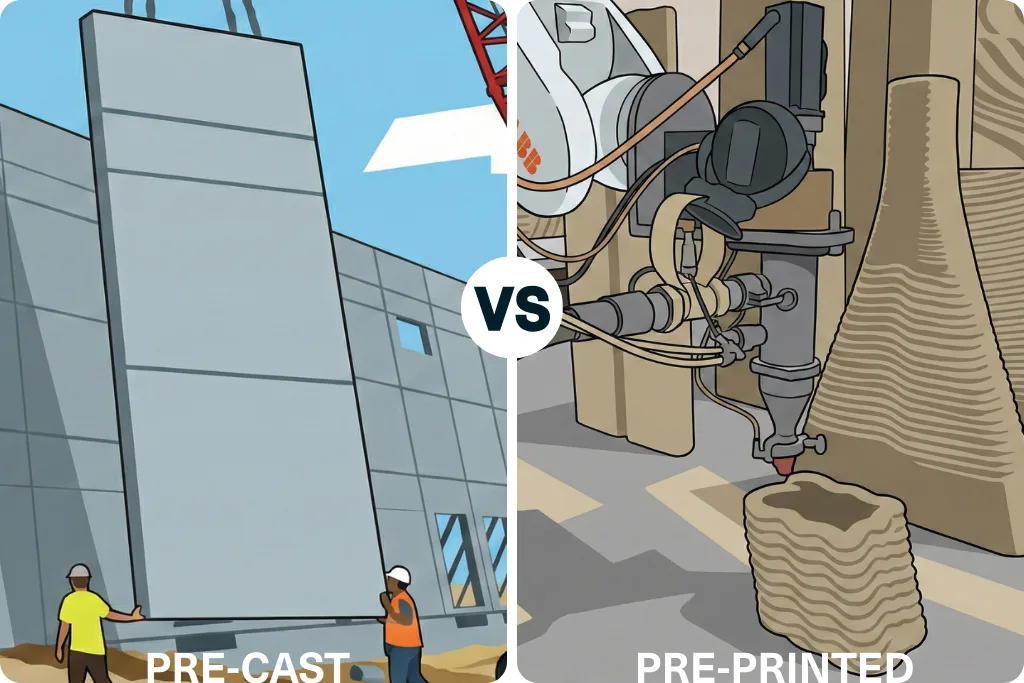
When specifying custom concrete elements for a project, architects and designers typically weigh two fabrication paths. The question of 3D printed concrete vs precast comes up more often as 3DCP continues to mature. Both can produce components off-site. Both deliver finished pieces ready for installation. But the way each one gets from design file to finished product, and what that means for your project’s geometry, timeline, and budget, can be very different.
Understanding where 3D printed concrete and traditional precast fits best isn’t about declaring a winner. It’s about knowing which method matches the specific demands of your design. This post breaks down the key differences so architects, landscape architects, general contractors, and developers can make informed decisions for their next project.
How Traditional Precast Concrete Works
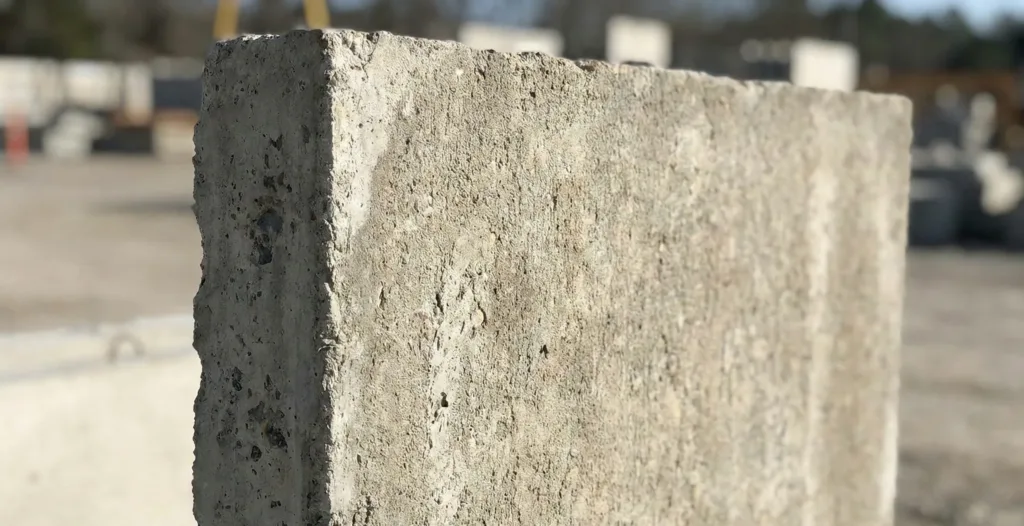
A detailed look at the raw surface texture of a rough precast concrete block prior to installation.
Traditional precast is a well-established fabrication method. Concrete is poured into reusable molds (typically made from wood, fiberglass, or steel) inside a factory or yard. Once the concrete cures, the piece is stripped from the mold, finished, and shipped to the project site for installation.
Precast has been the go-to for standardized structural and architectural elements for decades. It works well for repetitive, uniform components like wall panels, floor slabs, beams, and columns with consistent cross-sections. The controlled factory environment provides quality advantages over cast-in-place concrete, and because molds can be reused, unit costs go down as quantities go up.
Where precast runs into limitations is custom geometry. Curved surfaces, organic forms, textured patterns, and one-off shapes all require custom formwork. That’s where timelines and costs start to climb. Building a single-use mold for a complex shape takes skilled labor, time, and materials that add up quickly. For projects that call for unique design expression, the mold becomes a bottleneck.
How 3D Printed Concrete Fabrication Works
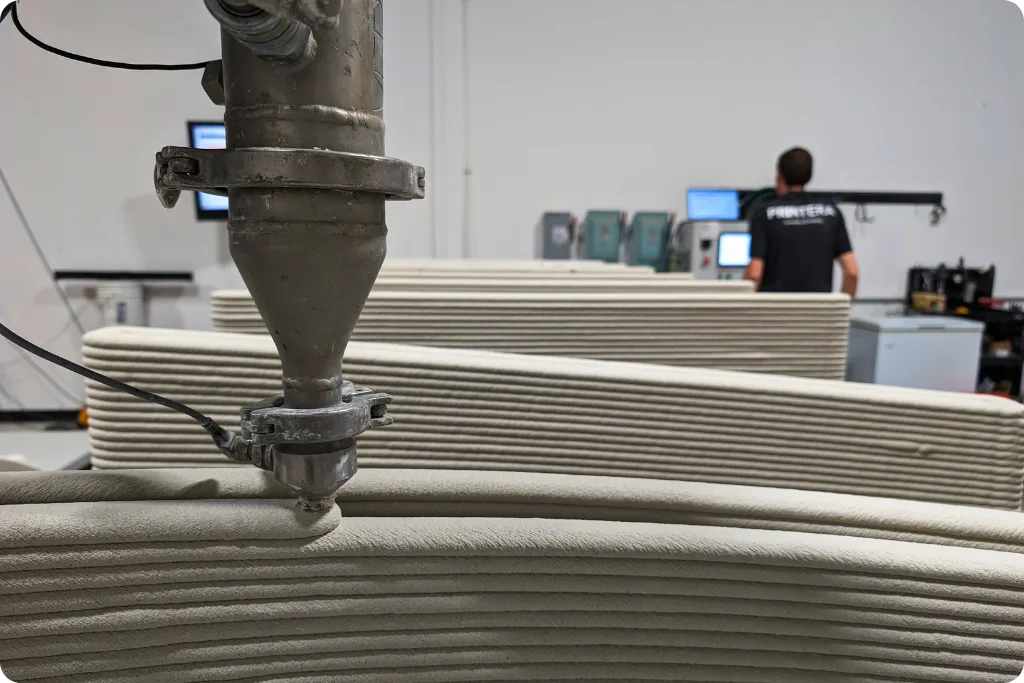
An up-close look at the 3D concrete printing process inside the Printera facility.
3D concrete printing (3DCP) takes a fundamentally different approach. Instead of casting concrete into a mold, a robotic arm extrudes concrete layer by layer, building a component directly from a digital file. There’s no formwork to build, strip, or store.
At Printera, this process happens off-site in a controlled warehouse environment using what we call the Pre-Printed method. Components are designed using parametric tools like Rhino and Grasshopper, printed on our robotic-arm system, cured under controlled conditions, and then shipped to the project site when the builder or contractor is ready for installation.
Because the geometry is driven by a digital model rather than a physical mold, changes in shape, curvature, or surface texture don’t require new tooling. A curved planter and a faceted column can come off the same print system with equal ease. This is the core advantage of 3D printed concrete for custom architectural and landscape elements.
Key Differences Between 3D Printed Concrete and Precast
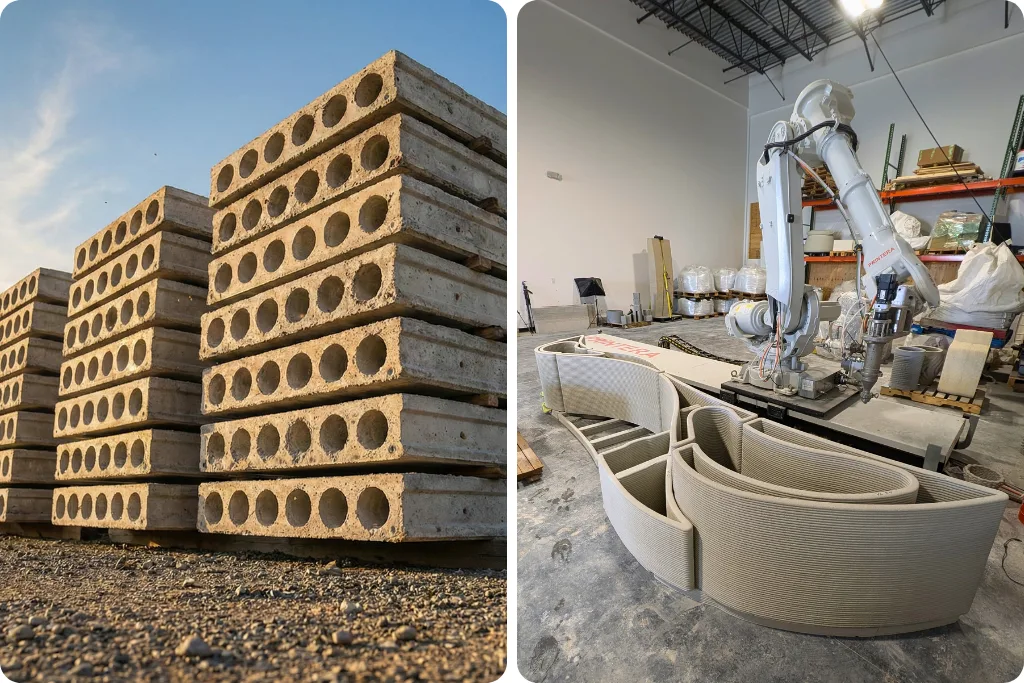
A side-by-side look at the automated extrusion process of 3D printed concrete (right) and the mold-based production of traditional precast concrete (left).
Design Freedom: 3D Printing vs Precast Geometry
This is where 3D printed concrete vs precast shows the sharpest contrast. Precast is efficient for rectilinear, repeated forms. But the moment a design calls for double curvature, variable wall thickness, or complex surface patterns, precast formwork costs increase significantly. With 3D concrete printing, complex geometry is inherent to the process. Curves, organic shapes, and intricate textures are produced without additional tooling cost. Printera’s projects, from Voronoi-patterned coffee bars to ripple-textured reception desks, demonstrate the kind of design freedom that would require expensive custom molds in a precast workflow.
Design Iteration Speed
In a precast workflow, once a mold is built, changes are expensive. Adjusting dimensions, tweaking a curve, or testing a new surface pattern means modifying or rebuilding the mold. In a 3D printing workflow, design iteration happens digitally. Printera uses parametric tools to generate rapid design variants, integrate client feedback in real time, and move to production without the lag of physical mold construction. For teams working through design development on a tight schedule, this compressed timeline can be a meaningful advantage.
Surface Finish and Texture
Precast concrete offers smooth, mold-finished surfaces by default. Textures and patterns can be added through form liners or post-production treatments, but each texture adds cost and complexity to the mold. 3D printed concrete offers more range than most people expect. The most basic finish is the signature layered look: visible layer lines that create a tactile, rhythmic texture inherent to the printing process. For many architectural and landscape applications, this is a design feature, not a limitation. It gives elements a craft-forward, material-honest quality that pairs well with modern and organic design language.
Beyond standard layer lines, Printera can oscillate the printer nozzle during production to create a variety of patterns and textures, including woven and rope-like effects and more organic, undulating surfaces. This gives designers additional options for surface expression without any change in tooling or added mold cost. And for projects where a smooth finish is preferred, a stucco coating can be applied to printed components by the installer on site, giving the piece a clean, traditional concrete appearance. The printed geometry stays intact underneath, and the finish simply adapts to the project’s aesthetic requirements.
This range of finish options means 3D printed concrete isn’t limited to one look. Whether a project calls for textured layer lines, patterned surfaces, or a smooth stucco finish, the same printed component can accommodate different aesthetic directions.
Cost Structure: Where 3D Printing vs Precast Economics Differ
Traditional precast has a clear cost advantage for high-volume, identical components. The per-unit cost drops with every reuse of the mold. For a developer producing hundreds of identical wall panels, precast is hard to beat. But for projects requiring a small number of custom pieces (a set of signature planters, a sculptural entry monument, or a series of unique columns) the economics shift. The mold cost in precast is a fixed upfront investment regardless of quantity. With 3D printing, there’s no mold to amortize. Each piece is produced directly from the digital file, which means custom geometry doesn’t carry the same cost penalty. Printera’s Pre-Printed method keeps production in a controlled warehouse, further reducing variables that can drive up cost on custom work.
Production Environment and Timeline
Both methods benefit from off-site production. Precast yards and 3D printing facilities alike offer controlled environments that reduce weather delays and improve consistency. The difference shows up in lead time for custom work. A precast project with custom molds may require weeks of mold fabrication before the first pour. A 3D printing project can move from finalized design to production more quickly, since the printer works directly from the model. For teams managing tight construction schedules, this shorter design-to-production window can help keep the project on track.
When Precast Is the Right Choice
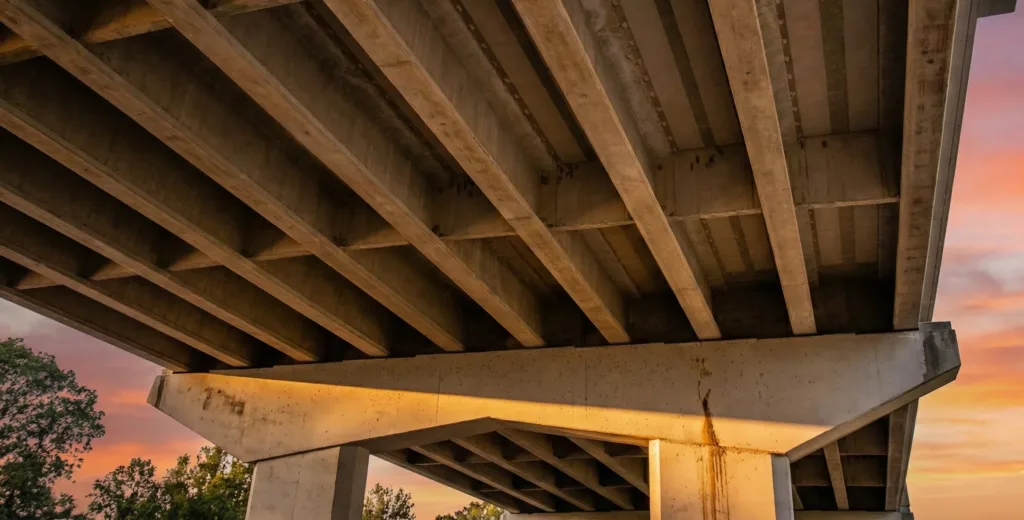
Low-angle photograph of a concrete highway overpass at sunset.
Precast remains the stronger option for projects that need large quantities of identical structural components, smooth or mold-finished surfaces without visible layering, elements with embedded reinforcement systems like prestressed tendons, or applications where established structural engineering standards and long performance histories are priorities. If a project calls for 500 identical panels or a standard structural beam, precast is the proven, efficient path.
When 3D Printed Concrete Is the Right Choice
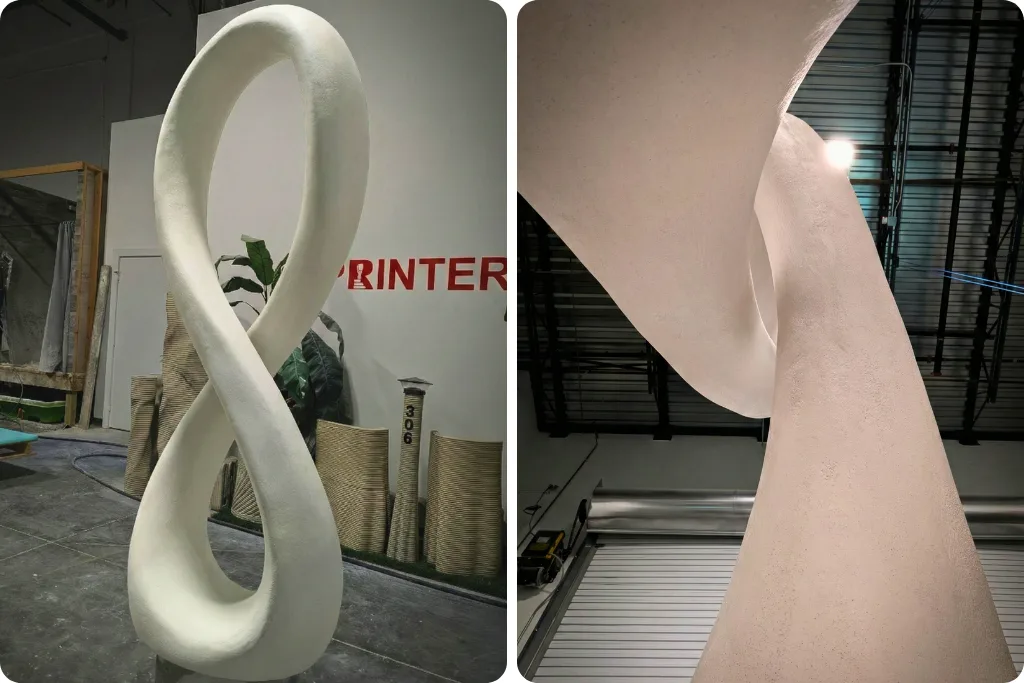
3D printed concrete is a strong fit for custom architectural and landscape elements where geometry matters. This includes facade panels and wall elements with curves or complex profiles, custom planters, benches, and site furniture with unique forms, monument signs and entry features with brand-specific geometry, commercial interiors like reception desks, bars, and counters with textured surfaces, and specialty applications like artificial reef structures.
Working with a 3D Concrete Printing Fabrication Partner
If 3D printed concrete is the right fit for your project, the engagement process looks different from a typical precast order. At Printera, we operate as a design-informed fabrication partner. That means we work with your team, whether you’re an architect, landscape architect, or general contractor, to translate design intent into print-ready geometry and a production strategy.
The typical workflow moves from design collaboration through parametric modeling, into Pre-Printed production at our Stuart, Florida facility, and then delivery to your job site. Your builder or contractor handles the installation. We fabricate and ship. We don’t install. This keeps the process lean and lets your on-site team maintain control of their schedule.
For projects where both methods might work, we’re happy to walk through the trade-offs specific to your scope. The goal is always to match the fabrication method to the design intent and the project’s practical requirements.
Choosing the Right Method for Your Next Project
The choice between 3D printed concrete vs precast isn’t binary. Both methods have clear strengths, and the best choice depends on the project’s design goals, geometry, quantity, and timeline. For standardized, high-volume structural elements, precast is efficient and reliable. For custom architectural and landscape components where design expression, complex geometry, and rapid iteration matter, 3D concrete printing offers a level of flexibility that traditional precast can’t easily match.
If you’re evaluating fabrication methods for an upcoming project and want to understand how Pre-Printed concrete components could fit, reach out to start a conversation. We’re always happy to discuss what’s possible.
Want to talk about your next project? Let’s connect. Explore more examples of our work in our project gallery.