
Custom Concrete for Hospitality: Bars, Desks, and Brand-Forward Interiors
Hospitality design in 2026 is moving toward interiors that feel layered, tactile, and rooted in a sense of place. As a result, designers are choosing materials that carry visual weight and age with character. Custom concrete fits that shift naturally. And with 3D concrete printing, the range of what concrete can do inside a restaurant, hotel lobby, or branded retail space keeps growing.
At Printera, we fabricate custom interior elements for hospitality and commercial projects using 3D concrete printing. We do this in our controlled warehouse facility in Stuart, Florida. From coffee bars and reception desks to high-top counters and branded feature walls, the process allows designers to specify complex geometry, integrated detailing, and distinctive surface textures. Most importantly, it does so without the cost and lead time constraints of traditional custom concrete work.
Here is what that looks like in practice and why more hospitality teams are bringing 3D-printed concrete into their interiors.
Why Hospitality Designers Are Turning to Custom Concrete
Concrete has a long history in commercial and hospitality environments. For decades, builders have used it structurally in walls, foundations, and monolithic elements. More recently, it has appeared in finished applications like countertops, flooring, and decorative surfaces. Now, however, the current wave of design trends is pushing concrete into a more expressive, visible role in interior spaces.
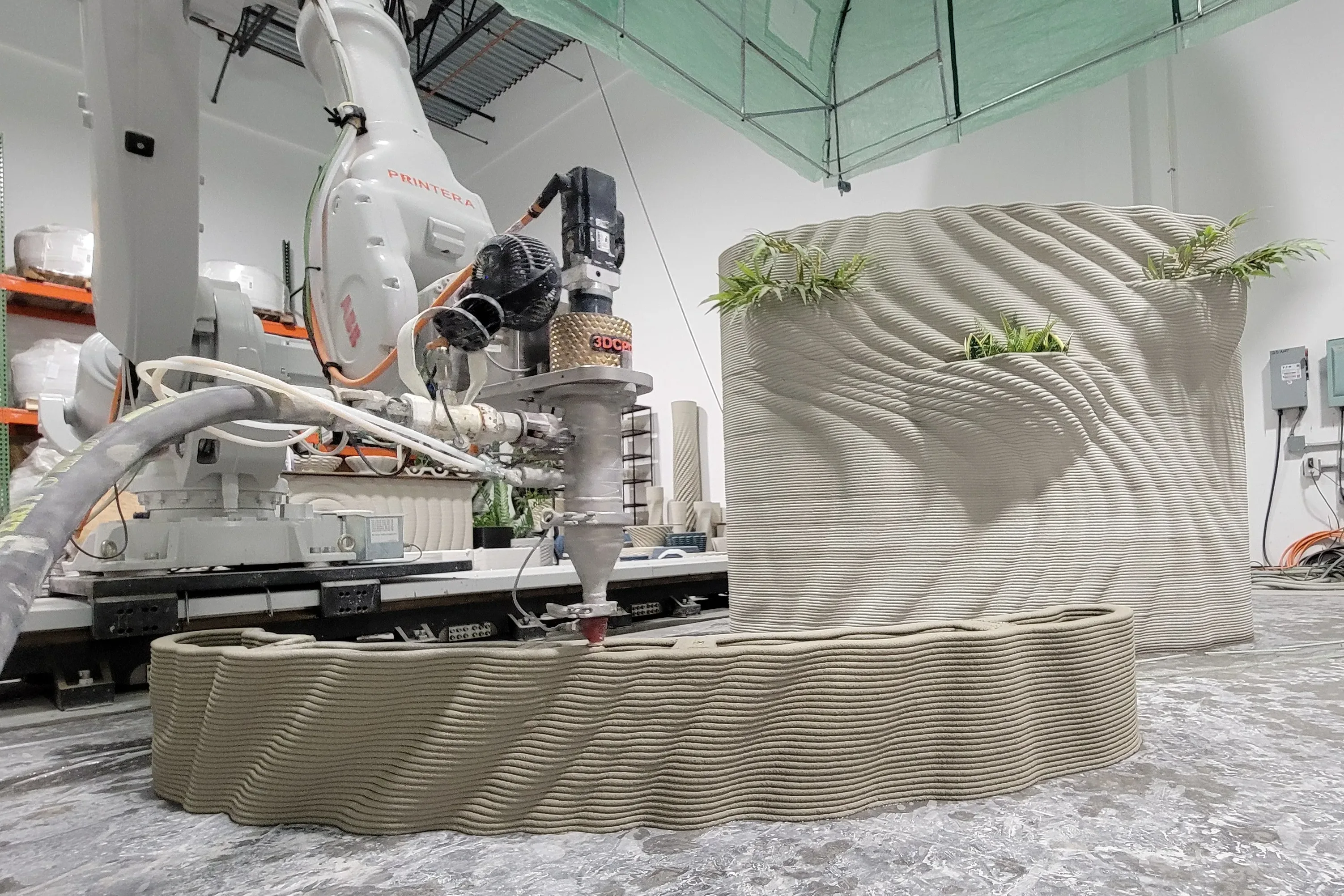
Custom concrete elements like this feature wall showcase the expressive, design-forward role concrete plays in modern interiors.
Hospitality interiors in 2026 favor materials that tell a story through their surface. Honed stone, natural wood, raw plaster, and concrete all carry a sense of craftsmanship and permanence. In contrast, manufactured materials struggle to replicate that character. Concrete, in particular, offers something both modern and elemental. It reads as substantial and intentional, whether it appears as a bar front, a reception desk shell, or a sculptural feature in a lobby.
The broader shift toward material honesty, tactile richness, and locally grounded aesthetics aligns directly with what concrete does well. Because of this, hotel lobbies, restaurants, and branded commercial spaces are increasingly turning to custom concrete for both durability and design expression.
What 3D Printing Adds to Custom Concrete Interiors
Traditional custom concrete for interior applications typically involves building formwork, casting, curing, and finishing. For simple shapes like rectangular bar tops, that process works well. However, when a designer wants a curved reception desk or a bar front with a branded pattern, formwork becomes the bottleneck. Complex geometry means complex molds, and that means higher cost and longer timelines.
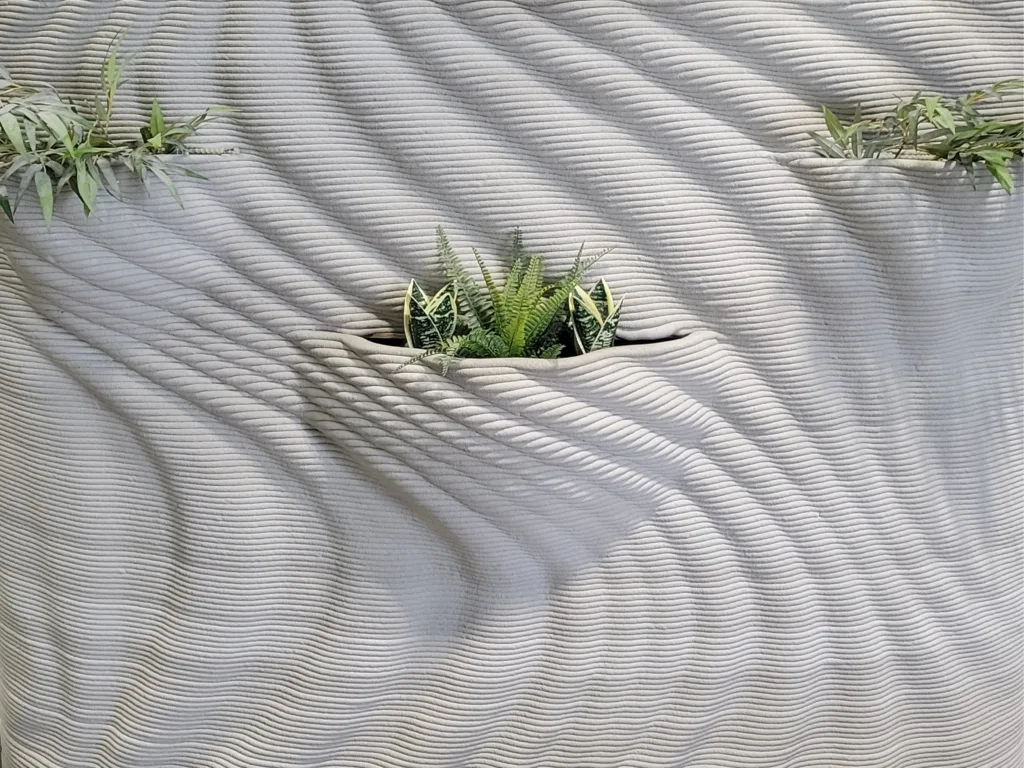
The layered detail of 3D-printed concrete, built directly from a digital model without traditional formwork.
3D concrete printing removes that constraint. The process builds each element layer by layer from a digital model. As a result, the cost difference between a straight surface and a curved one stays comparable as long as the print time is similar. For example, a reception desk with a flowing, organic profile does not require a custom mold that gets used once and discarded. Similarly, a bar front with a geometric texture can come directly from the design file.
This is a practical shift for hospitality projects where design budgets are real but design ambition is high. Essentially, 3D printing lets the design intent drive the form rather than having formwork economics dictate what is feasible. For a closer look at how this compares to traditional methods, see our post on 3D printed concrete vs precast.
Where Custom Concrete for Hospitality Is Gaining Traction
Printera is seeing growing demand for 3D-printed concrete in hospitality and commercial interiors. More specifically, the requests coming in involve branded reception desks, restaurant bar fronts, and feature elements. In each case, designers want something that carries the identity of the space in a material that performs under daily commercial use.
What connects these projects is a shared need. The design calls for a custom concrete element with non-standard geometry or surface detail. At the same time, the traditional path of building one-off formwork either costs too much or takes too long.
Common hospitality applications include custom bar fronts and counters with textured or patterned surfaces, reception desks with organic profiles, feature walls that set the tone for a space, and decorative columns that define zones within open floor plans. Additionally, the pattern surface possibilities are broad. Geometric textures, wave-inspired profiles, organic forms, and brand-driven patterns can all come directly from a digital model. This eliminates the mold-building step that typically makes these designs cost-prohibitive.
In each case, the printed concrete arrives at the project site as a finished component, ready for the contractor or installation team to place.
The Role of Texture in Hospitality Concrete
One of the strongest design arguments for 3D-printed concrete in hospitality is the surface itself. The layered texture that results from the printing process is not a byproduct to be hidden. Instead, it is a visual and tactile quality that designers increasingly specify on purpose.
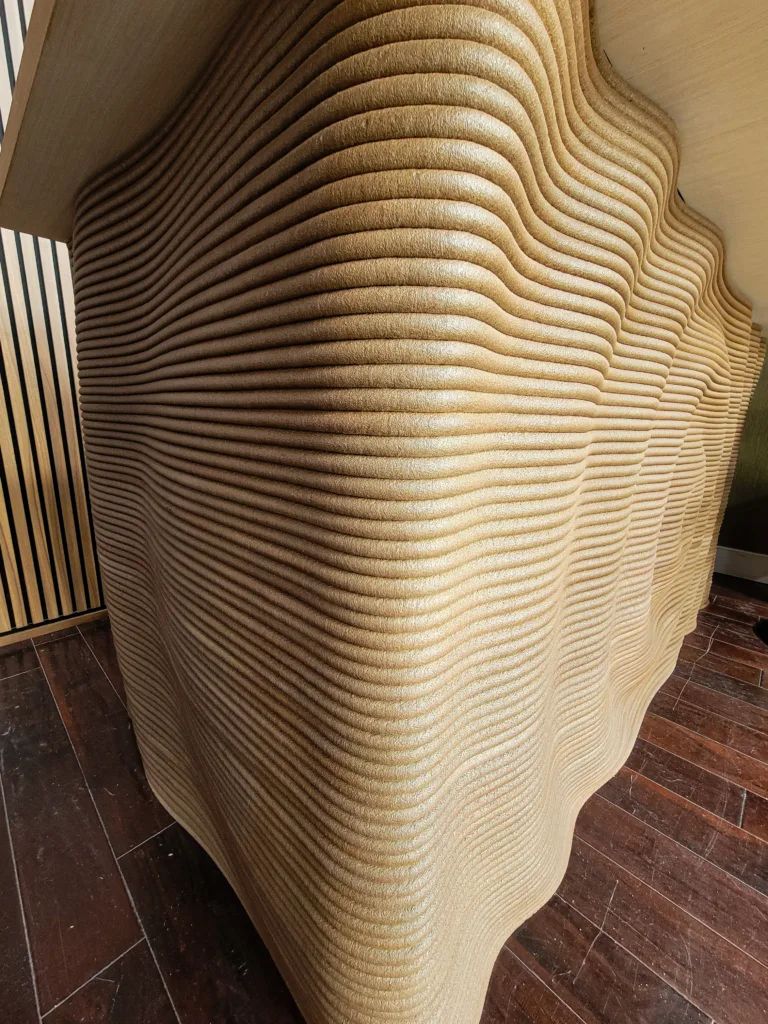
A custom reception desk featuring a textured surface pattern, demonstrating material honesty in 3D-printed concrete.
In a hospitality context, this matters considerably. The broader industry trend toward material honesty and sensory-rich interiors rewards surfaces that reveal how they were made. With 3D-printed concrete, the layered surface is a direct expression of the fabrication process. Therefore, leaving it exposed rather than covering it with stucco or a skim coat is a deliberate choice. It lets the material speak honestly about its origins. That transparency resonates with designers who already specify raw plaster, exposed aggregate, and natural stone for the same reason.
The texture also photographs well. This is not a small consideration for restaurants and hotels where the interior is part of the marketing. A textured concrete bar or reception area reads as distinctive and intentional, both in person and on screen.
Practical Considerations for Hospitality Projects
Working with 3D-printed concrete in a hospitality interior involves a few practical details. Designers and project teams should plan for these early.
Sealing and finishing. Interior concrete elements, particularly in food service environments, need appropriate sealing to resist stains and support cleaning. Printera works with project teams to match surface treatments to the intended use.
Coordination with other trades. Custom concrete elements often need to integrate with electrical, plumbing, or millwork. Because 3D printing builds from a digital model, the team can design openings for wiring, conduit, or mounting hardware into the geometry from the start. This reduces the need for field modifications after delivery.
Weight and structural support. Concrete is heavy. As a result, hospitality interiors on upper floors or in structures not originally designed for concentrated loads need early structural planning to avoid surprises during installation.
Installation. Printera fabricates and delivers. The contractor or installation team on site handles placement. We provide coordination support and setting details to make that handoff smooth. However, it is important to plan for rigging and access, particularly in tight interior spaces.
Lead time. For hospitality projects on fast-track schedules, engaging early allows Printera to run fabrication in parallel with other buildout activities. Because of the Pre-Printed approach, concrete elements can be produced off-site while the space is still under construction. They then arrive when the site is ready for installation.
Beyond Bars and Desks: Other Hospitality Applications
While bars, counters, and reception desks tend to be the first applications hospitality designers think of, the scope goes further.
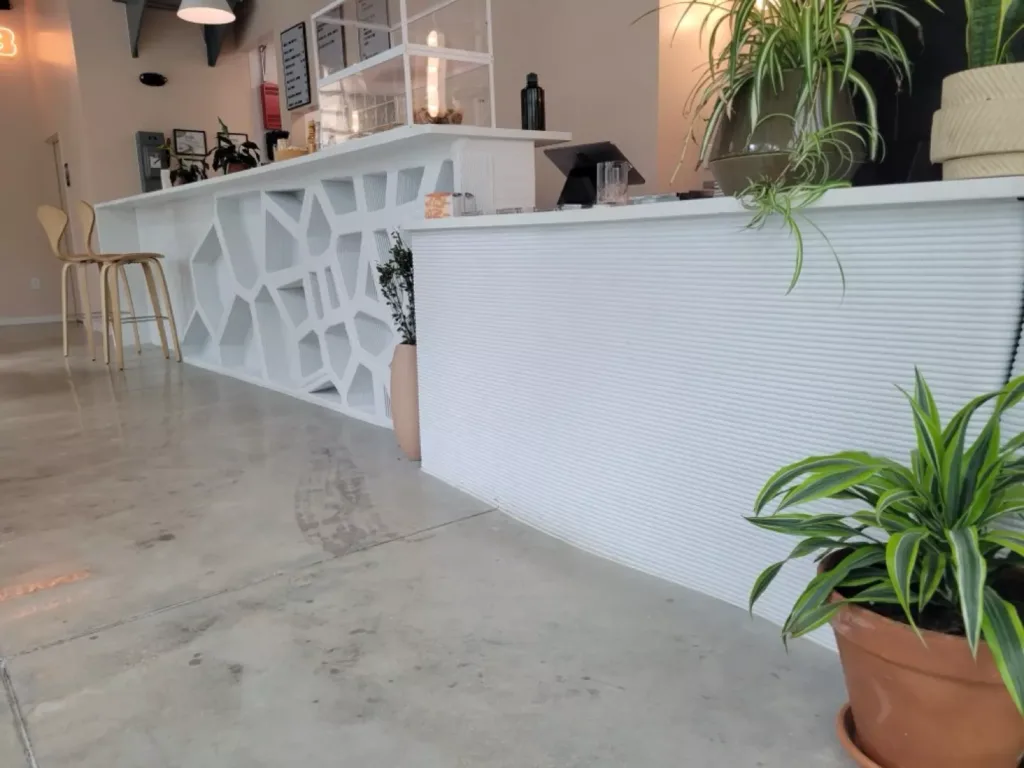
A range of custom 3D-printed concrete components in production at Printera’s facility, ready for hospitality and commercial projects.
For instance, branded feature walls and entry monuments create a strong first impression for hotels, restaurants, and retail spaces. Architectural planters bring greenery into lobbies and outdoor dining areas with forms that match the project’s design language. In addition, decorative columns and screen walls can define space and create visual separation without the uniformity of standard building products. Exterior signage shells also allow brands to carry their identity from the street into the interior with a consistent material vocabulary.
Each of these applications benefits from the same core advantage. 3D printing makes custom geometry accessible without the cost penalties that typically push projects toward simpler, standardized solutions.
Getting Started on a Hospitality Project
If you are an architect, interior designer, or project manager working on a hospitality interior that calls for custom concrete, the best time to bring Printera into the conversation is during design development. Early involvement allows us to advise on what is printable, coordinate geometry with other building systems, and align production with your timeline.
We work as a fabrication partner alongside your existing project team. We provide Pre-Printed concrete components that your contractor installs on site. The process starts with a design conversation, moves through digital modeling and prototyping if needed, and ends with finished elements delivered to your project.
Reach out to explore how 3D-printed concrete could fit your next hospitality project.